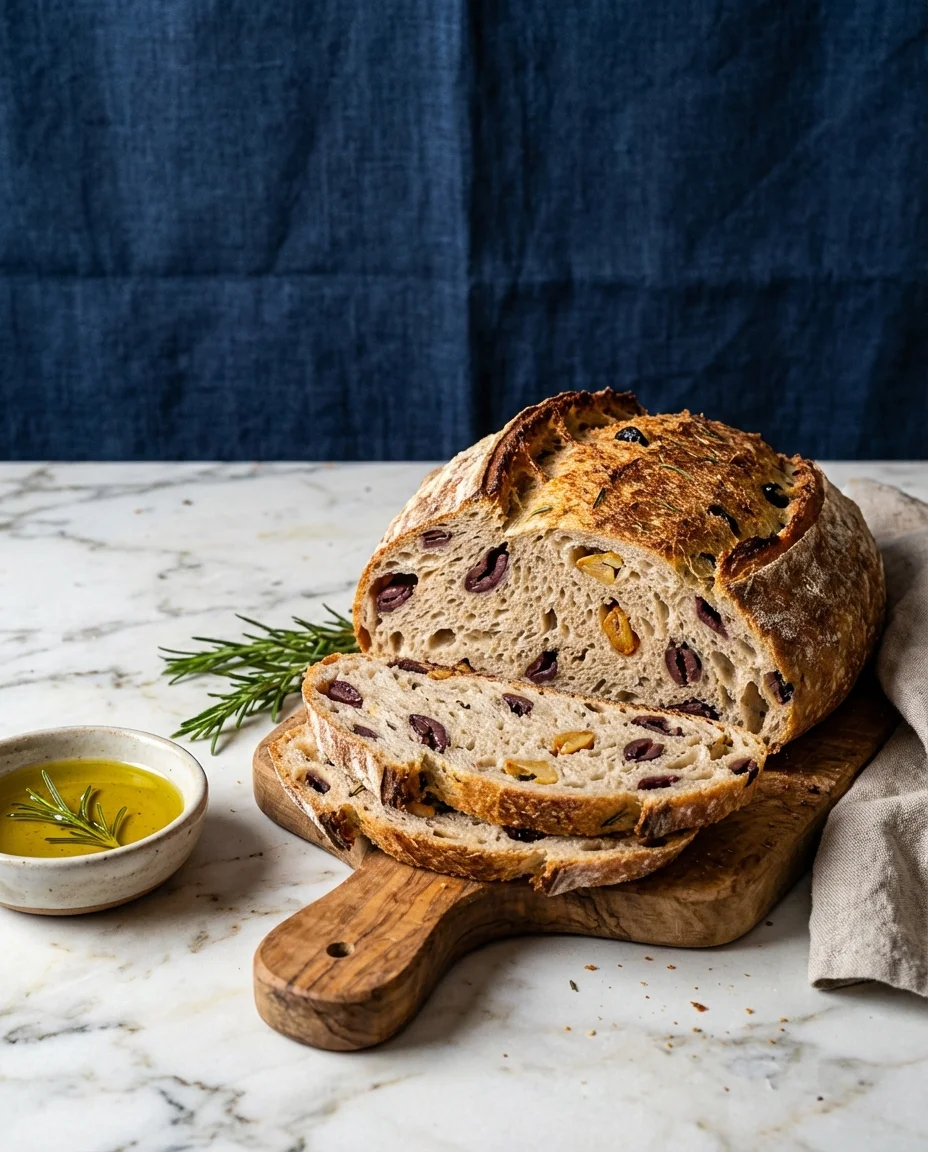
Rosemary Olive Sourdough Bread
Craft a flavorful Rosemary Olive Sourdough Bread with roasted garlic that requires no kneading and rises overnight. This crusty loaf, made with active sourdough starter, is infused with aromatic rosemary, savory kalamata olives, and tender roasted garlic cloves, offering a delicious alternative to classic sourdough.
Price per Serving
Instructions
- 1
At night, in a large bowl, mix organic white bread flour (4 cups) and sea salt (2 teaspoons) together. In a small bowl, mix sourdough starter (0.33 cup) and water (1.875 cups) together using a fork. Pour the starter-water mixture into the flour mixture and stir with a fork until relatively combined. Scrape sides and mix dough for one minute, incorporating all the flour. If the dough will not incorporate all the flour, add water (1 tbsp) at a time. Cover with a [damp kitchen cloth], wait 15 minutes and do 2 sets of stretch and folds, 15 minutes apart.
- 2
Let dough rise overnight on the counter (10-14 hours at 65F-70F). In the morning, the dough should have swelled, but not quite doubled. Do the poke test.
- 3
Prepare your [banneton] by dusting it with [rice flour] and optionally some [kalamata olives] and [fresh rosemary] at the bottom (which will end up being the top). See notes for using a regular bowl.
- 4
Using a [wet dough scraper] or wet fingers, loosen the dough and pour it onto a well-floured surface. Gently flatten into a rough rectangle (approx. 1.5 inches thick). Sprinkle the chopped kalamata olives (0.75 cup), fresh rosemary (2.5 tablespoons), and roasted whole garlic cloves (0.5 cup) over the surface. Using the [dough scraper], lift one side, stretching up and over to the middle, then fold up the other side, like a tri-fold envelope. Turn the dough horizontally. Let the dough rest for 10 minutes. Repeat the gentle flattening and tri-fold. Pinch the seams closed and lift into the prepared [banneton], seam side up.
- 5
Place dough in the fridge uncovered for hour (1), while you preheat the oven to 500F (or 475F) with your lidded [dutch oven] inside.
- 6
Pull the dough from the fridge and have your [lame] (or sharp knife or razor blade) ready to score. Place a piece of [parchment paper] over the [banneton] and flip the dough, setting it down on the counter over the [parchment paper]. Score 0.75-1 inch deep at a 45-degree angle. One slash is fine, or create a design.
- 7
Pull the [dutch oven] from the oven and close the oven door. Remove the lid, place the scored dough into the [dutch oven], lifting it by the corners of the [parchment paper]. Quickly cover and place back in the oven.
- 8
Place in the middle of the oven for minutes (20) with convection on (or 25 minutes with no convection, or 28 minutes at 450F). Remove the lid, and the interior should reach 200F (if not, replace the lid until it does).
- 9
Once the internal temp is 200°F, uncover the bread, lower the heat to 450°F, and continue baking [10-15 minutes] until deeply golden and the internal temp reaches 204- 208°F. No pale loaves please, let them get golden!
- 10
Remove from the [dutch oven], let it cool hour (1) on a [wire rack] or tilted up on its side, before slicing so you don’t let the steam out and don’t smash it. Be patient. Take a picture! Feel proud. You did it!
Nutrition Facts
Per portion
Macronutrients
Micronutrients
Reviews
Be the first to review this recipe!
Rate this recipe:
No reviews yet. Be the first to share your experience!